How To Choose A Touring Bike For Long-Term Cycle Touring

I’m going to start by saying this: you could take almost any bike on a long-term cycle tour.
If Ed Pratt can cycle around the world on a unicycle and Tom Allen can ride an upcycled vintage mountain bike across Armenia, then you could (probably) ride the bike out of your shed.
But then, you need to wonder whether that bike really is fit for purpose. If there’s one thing you need if you want to travel by bike for a long time, it’s comfort. Enjoying your time in the saddle is the only prerequisite to a successful bike trip.
There are also some logistical implications; you want your bike to be fixable no matter where you are in the world. This is especially important for long-term cycle touring; some parts are more globally available than others.
There is also one thing I simply cannot account for, and that is your personal preference and needs. Nevertheless, in this article, I’ve tried my best to think of everything to help you choose the right touring bike for you.
I’m working through the key considerations for choosing a bike for a cycle tour. I will also point you toward the decisions we made for our bikes, which have cycled across twenty-seven (and counting) countries. We’ve also shared our full bike set-up here!
In this article
- Key features of touring bike
- The Seven considerations before buying a touring bike
- Your FAQs on choosing the right bike for a cycle tour answered
How we chose our touring bikes to cycle around the world
When we chose our bikes to cycle around the world, we focused on functionality and comfort. Money didn’t really factor in; they would cost what they cost and be durable, reliable, and high-spec.
We were riding loaded to tour over 30 countries over two years. The bikes had a lot of work to do, so we opted for brand-new, custom-built bikes and high quality parts.
I’m telling you this because it’s good to understand the context behind our decisions. Plus, your objectives might be different from ours, especially if budget plays a role in your decision-making or if you’re on a much shorter tour.
It will help if you know what your non-negotiables are when it comes to choosing your bike. If you’re unsure what they are yet, the next two sections will help you.
SEE OUR BIKE SET UP & SPEC
Check out our full bike set up and full specification.
Key features in touring bikes
Before we dive in, let’s take a quick look at traditional touring bikes and their key features.
- Steel frame for comfort and durability.
- Frame geometry: longer wheelbases and longer chainstays for easier steering and better balance when carrying loads. They also have a more upright riding position for comfort during long rides.
- High gear ratio, so you can ride those hills while loaded.
- Good brakes, so you can stop 30kg+ as it speeds down a hill.
- Wide tires for comfort.

The seven considerations before buying a touring bike
You need to think about seven main considerations before buying a touring bike; let’s walk through each one, list your options, the advantages and disadvantages, and finally, we’ll give you a steer on what we did.
The type of touring you’re doing
Different bikes handle different types of touring. It helps to know how you want to tour before you buy your bike so you can buy a bike that is best suited to that type of tour. For example, if you’re touring with a light load, staying in hotels, and carrying a credit card, you might be able to save money by opting for a cheaper frame.
Let’s look at some touring types and why they’re worth considering.
Long-term touring with a loaded bike
This means you’re riding with all your kit, tent, kitchen, clothes, tools, etc. This is the type of touring that we generally do.
What you might choose: You’ll likely need a sturdy steel frame to cope with the weight and distance. The steel frame will also make for a comfier ride. A great gear ratio will help you get that heavy load up the bikes.
Credit card touring
Credit card touring is generally lighter and faster. You’ll travel between hotels, throw money at problems, and eat out. Sounds pretty sweet, actually! This is the type of cycle touring we did across the Outer Hebrides.
What you might choose: a lighter and less durable frame since the bike will be doing less work. You can save money on the frame if you don’t need to ride loaded.
Touring on the road
If you’re touring predominately on roads, then you’re generally riding on minor, well paved roads. You’ll be alongside the cars but on the quieter rides and joining the cycle paths. We almost always tour like this.
What you might choose: a sleek, aesthetic bike. You’ll need to worry less about mud and clearance between mudguards and tires since you won’t be dealing with the mud too often. You can also take thinner tires for this type of touring.
Off-road touring
If you’re riding off-road, you’ll likely encounter gravel, mud, and some more technical terrain.
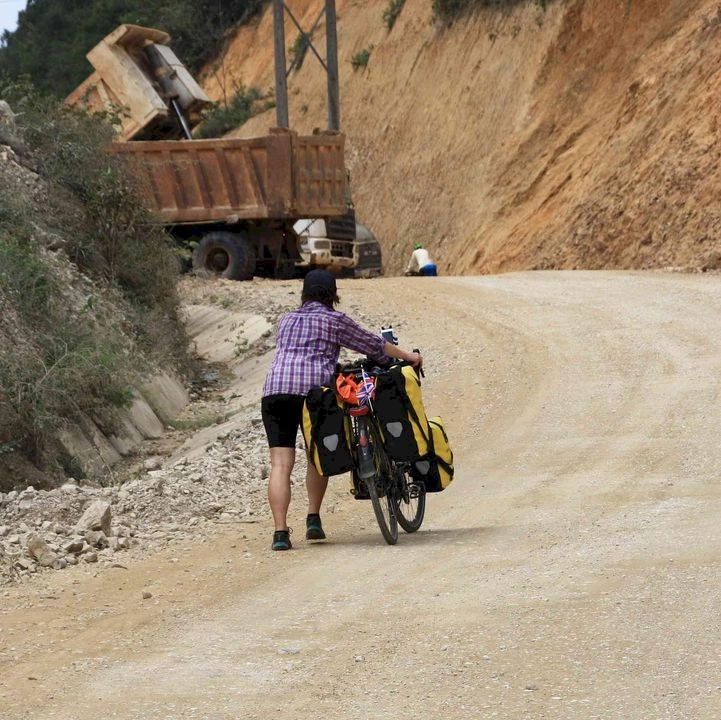
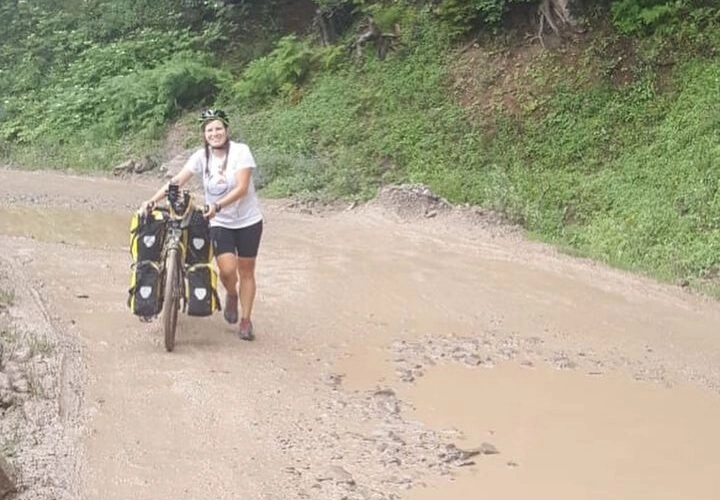
What you might choose: a durable frame to handle the variable surface, wider tires, and more grip. You will want clearance between your tires and mudguard. Otherwise, you’ll end up like me on Gordezi Pass in Georgia; I had to stop every five minutes to pull mud out of my mudguard!

The type of touring we chose: long-term touring with a loaded bike, riding predominately on roads.
2. Secondhand, new, or custom
Whether you buy second-hand, new, or custom, you will likely be persuaded by your budget and/or your commitment to recycling what’s already out there.
Custom touring bike
The major benefit of a custom bike is that you can get exactly the right fit, and you can meet all your preferences. You’ll have your bike exactly as you want it, from the frame down to the components. Naturally, this is the most expensive option.
New touring bike
Everything will be fresh and new. Your bike will last a long time, which is good peace of mind if you’re traveling long-term. You’ll find your perfect bike faster than secondhand since you have all the options available to you. Plus, you’ll get a warranty if something goes wrong.
Used touring bike
The most cost-effective option, but you may need to make some sacrifices since this bike has likely already been fit and spec’d to someone else’s liking; not an issue if you have the same preferences.
If there’s one thing you need to be very conscious about when buying a bike for long-term cycle touring, it’s bike fit. I’ll go into this in more detail later, but comfort is everything. If your bike doesn’t fit correctly, you can cause all sorts of issues like back pain, joint pain, and saddle sore.
Another consideration with a used bike is the wear and tear that it’s already experienced. Before setting off on a tour, it’s a good idea to have the bike checked over by a professional, as riding on a worn-out drive train or brakes will not be very pleasant. If you’re touring outside the “Westernised” world, you will have a difficult time getting hold of good quality components, so it’s a good idea to make sure everything is working and in good condition before setting off.

Second-hand or new, the type of bike we chose: we went with a custom built bike. We were asking our bikes to do a lot of miles (24,000) with a lot of weight (20 - 40kg of luggage.) The bikes needed to be up for the challenge.
3. The frame
You can choose a bike frame for touring based on the type of touring you’re doing while considering your budget.
Frame composition
Traditional touring bikes are made from steel. A steel bike is strong, durable, and comfortable to ride. Steel can absorb shock better than aluminum, for example.
The downside to a steel frame is the weight. With durability comes weight. But, if you’re traveling long-term and riding loaded, this is really what you need.
An alternative to steel is aluminum, which is lighter and a lot cheaper. I did my first bike tour on an aluminum bike; I cycle toured John O’Groats to Land’s End on an 8kg aluminum hybrid. It was absolutely fine and perfect for that type of touring. I was credit card touring with no more than 3kg of luggage.
If you’re traveling long-term and across many countries, think about the worst-case scenario. How would you repair your frame if it were to break? You will always find a way to repair steel; steel can be welded. Aluminum, on the other hand, may not be so easy to repair.
Frame size
Your frame size is so incredibly important. I’ve already said this, but I’ll say it again: go to a professional and get fitted before you embark on long-term cycle touring.
Even a few millimeters can make such a difference to rider comfort. The last thing you’d want is to set off from home, ride into your sixth country after thousands of miles, and come to the realisation that you can’t handle the discomfort anymore.
A poorly fitted bike can result in back pain, joint pain, or saddle sores. Bike shops can sit you on an adjustable bike and help you get the perfect fit. While you’re there, you can try different saddles and get amazing consultancy from bike touring pros.
Our frames: we opted for a steel frame touring bike. We bought the Genesis Tor De Fer frame set and built the bike. At 6”4, Stew rides the XL Tour De Fer and Zoe, 5”3, rides the S.
4. Wheels, tires, and spokes
The strength of your wheels is crucial when you’re carrying heavy loads. The right wheel composition will prevent broken spokes and other unsavory issues on the road.
Tires
Your tires will be dependent on the type of touring that you’re doing. For road touring, we absolutely love the Schwalbe Marathon Plus. Ideal for long-term road touring because they’re durable and puncture-resistant. That said, if you’re riding off-road, you probably want something with more tread.
Wheels and spokes
Look for wheels with at least 32 spokes for better durability. In terms of wheel size, 700c is the standard for road touring, but 26-inch wheels might be preferred for off-road touring or touring in developing countries where 26-inch tires and tubes are more readily available.
Mudguards
When choosing your bike to cycle long-term, consider the type of touring you’re doing and how much of a muddy mess you’re going to end up in.
We do all our bike tours on a Genesis Tour De Fur. It’s perfect for us as we spend a lot of time on the road and out of the mud. But, this bike has much less clearance around the wheels. Since the mudguards sit close to the wheels, if you do end up a muddy stretch of road you’re going to have issues with mud being stuck. The benefit of this design is less drag.
If you’re travelling off-road then bikes like the Surly Long Haul Trucker might be better for you.
Our wheels, tires and spokes: 700s wheels, Schwalbe marathon plus tires and 32 spokes.
5. Gearing
The gearing system is very important for touring. Naturally, gearing is going to help you significantly on different terrains and gradients.
Unless you’re riding very light, you’ll likely tour with a triple crankset so you can access some super-low gears. You’ll be so glad you’ve got those granny gears if you end up grinding uphill for a day or two like we did in Georgia and China.
We opted for a 10-speed cassette for even more gear range if you wanted to, you could happily settle for a nine-speed or maybe even eight on the back if you wanted to save a bit of weight. The important thing is to make sure your biggest ring at the back will allow for easy hill climbing.

Our chosen gears for long-term bike touring: we ended up with a 26-toot sprocket at the front and 34 34-tooth sprocket at the back. We’ve got a triple 10-drive train setup.
6. Brakes
There are two main types of brakes for touring bikes: rim brakes and disc brakes.
And like most things, brakes cause all sorts of heated debate…
Rim brakes
Rim brakes are readily available worldwide and and easier to repair, which are some of the major reasons for making them a popular choice for long-term touring. One thing to consider on a big tour such as a world tour is that rim brakes will cause significant rim wear and may result in the need to replace the rims.
Disc brakes
Disc brakes offer better stopping power, especially in wet or muddy conditions. If you’re riding a very heavy bike you might prefer disc brakes for this reason. They may be harder to repair in certain parts of the world.

Our chosen brakes for long-term bike touring: we opted for disc brakes for their stopping power. Haven’t had a problem yet!
Brake shifters
The brake shifters you choose will likely depend on your handlebar setup. For me, comfort is key here. I cycled 13,000 miles with drop bars, then switched to the standard flat bar, and it was the best decision ever.
Drop bar shifters
Drop bar shifters are often selected for their aerodynamic design and range of hand positions. On long rides, you can shift into multiple positions to give your hands, wrists, and shoulders a break. The brake lever is longer so you get more leverage; it’s generally easier to shift.
Flat bar shifters
Flat bar shifters keep you in an upright position for the day. Naturally, this position is less aerodynamic and you’ll be stuck in basically the same position for the whole day. You’ll be changing gears with just your thumb and there’s less leverage.
The brake shifters we chose for long-term touring: our shifters/handlebars are the only thing different about our bikes. Stew rides with drop bars and Shimano 105 shifters whereas Zoe prefers the flat bar.
Your FAQs on choosing the right bike for a cycle tour answered
Choosing the right size bike for touring is really, really important. To be honest, the best thing you can do here is find a professional and have them measure you. Even a few millimetres can make a huge difference in comfort when you’re riding a bike for hours a day.
Yes, you can use any bike for bike touring, but some bikes are more suited to longer-term tours. My first bike tour was John O’Groats to Land’s End, and I did it on an Islabike, the Beinn 29. It was a hybrid bike and perfectly fine for my adventure.
If you’re a beginner cycle tourist, then I highly recommend giving it a go with what you’ve got. If you love it, then you’ll know it’s worth the investment for something a little more sophisticated.
You could cycle tour with a carbon frame, but you’d need to be careful about luggage and weight. I would expect anyone touring on a carbon bike to be riding very light.
The best bike for long-distance biking is the most comfortable bike for you. I know that’s not too helpful, but it does depend on your type of adventure and preference. I’d suggest a steel frame touring bike with a decent gear ratio and disc brakes for touring on roads. We share our full bike touring setup and a guide for beginners.
Some of the key differences between road bikes and touring bikes are the tires, the gearing, and the frame.
Generally, road bikes are designed to be fast and light, so weight is reduced with fewer gears and a lighter frame like aluminium or carbon. Touring bikes are designed to be durable. Touring bikes are commonly steel framed with a better gear ratio, so you can easily manage the hills while loaded. The touring bike generally has wider tires and thicker tires, too.
Touring bikes are generally heavier and kitted out with thicker tires with more tread. A combination of these factors means they’re generally slower. That said, these factors are generally desirable for touring.
No, you definitely don’t have to have a touring bike. In fact, my first tour was completed on a hybrid bike, and I had no issues at all. I still ride that bike now. I’d encourage you to try your first tour on any bike you’ve got. You can always buy a new bike later.
A hybrid bike is not strictly a touring bike, but as the name suggests, a hybrid can be used as a touring bike. I did my first bike tour on a hybrid. It was around 1,000 miles in about two weeks. The hybrid was great for it!
Our touring bikes have a 26-tooth sprocket at the front and 34 34-tooth sprocket at the back. Generally, touring bike gears are designed to give you nice low granny gears so you can grind up the hills when you’re fully loaded. Most touring bikes will have a triple crankset.
Generally, a touring bike will be slower than a road bike, but tourers aren’t generally racing. The touring bike is built to be durable and easier to ride, with extra gears to make the hills and weight easier to manage.
Post written by: Zoe Ashbridge
Comments
Ask a question or join the discussion below.
Go back to Cycle Touring Guides to see more content like this or checkout similar content below.
Back to Cycle Touring Guides
Thank you for sharing your cycling wisdom with the world! Both inspirational and informative.
Would you have any personal tips to offer concerning air-travels with your bikes? Particularly, for those traveling solo with a bike.
Hi, Jill!
To be honest, I can’t think of anything specifically for flying alone with a bike but that may be because Stew and I have always been together. If it’s helpful you can read our blog about flying with a bike. It’s got all our best tips!
Jill, re air travel, you may be interested in something I came across not so long ago.
In short, there’s a (full-size, large-wheel) folding bike called the Montague Navigator, which, with a lot of ingenuity, can be folded up so that it can fit into the very largest of pizza bags! This means, incredibly enough, that it can go into the hold of an aircraft as normal hold luggage on a lot of airlines. Google on the idea and you will find a full explanation by someone called James Sowerwine.
About 3 months ago I went and bought a Montague Navigator. I haven’t yet attempted the technical modifications explained by James in his account, or even acquired a super-size pizza bag. But the bike functions perfectly well as a normal cycle here in London. I have fitted a rack, etc.
It’s just that it occurred to me: normally travelling with a cycle (in Europe at least) as hold luggage is shockingly expensive. And hiring a cycle in a destination is not much better. If you buy your own “qualifying bike box” (for hold luggage), you also have to pay to keep your bike box in the airport while you go off cycling at your destination.
Also, renting a good bike in most locations in Europe is astronomically expensive. Basically, I don’t know what the situation is wherever you live (you spell “traveling” with one L, so I’m assuming North America), but in Europe flying + cycling = stuffed. However, if you can disguise your bike as standard hold luggage …
Thank you so much for taking the time to write this detailed comment, Mike! Really kind!
Great info, and everything info wise is great, but a little something if your a heavy rider like myself spend the money for a custom wheelset. Velocity makes a decent beginner wheelset as well as expensive. A heavy rider needs to increase the spoke count. I’m 6’2 and 285lbs and with gear a 32 spoke 700c will never last. I run 40 spoke in the rear and 36 in front after popping 4 spokes on my 32 spoke wheelset that came factory in the absolute middle of nowhere.
Also if you have the $ and something for frame material that wasn’t mentioned is Titanium. I absolutely love mine! I started with steel and progressed to Titanium. Now that being said if your riding out of country or some remote places stay with steel as it is the easiest to repair. Also buy good bags that don’t leak, there are some good brands out there that have a great reputation. Just my two cents in what I’ve learned the hard way! Great Article!!
This is a great comment, James! I especially value the comment about the custom wheelset. we were riding with at least 35kg, upto 50kg, and our 32 spoke wheels were fine, but if running 40/36 works for you, we fully support that!
Agree also on the frame material. Glad you love your titanium frame. Everything you say about steel being the easier to repair is correct. We actually followed someone on Instagram who cycled around the world on an aluminium frame, so the frame material really does not have to be steel, though, I’m not sure I would go with anything but steel haha.
As for bags, agree again, a good set of bags that manage the rain is a must. We gave Ortlieb panniers a five star review here, we absolutely love them.
Thank you for your insightful comment! Your thoughts and experience will be really useful for others to read, especially that custom wheelset.
V Useful. Thank you. I’ve bookmarked it so I can keep coming back to it as I get further into the bike choice decision
So glad you found it helpful! Don’t hesitate to reach out if you need anything else.
This was a really helpful article for helping me to decide what type of bike to get for my very first tour (10 day Hebridean Cycle Way!)
I’m so pleased this helped! What bike did you go for?
We cycled the Outer Hebrides two years ago. It wasn’t Hebridean away exactly but I think we did most of it. Here’s the blog if it’s of interest 🙂
A very informative article! I almost went with a derailleur system. In the end, I went for a Rohloff hub and a Gates carbon drive. Very happy with it. For tyre size, I went with 650b x 57mm. It’s a bit slower on the road. But I’m not bothered about that. After all, I won’t be in a rush. 🙂 They will certainly be useful on goat tracks.
Nice! Glad you enjoyed the article! Double glad that you found a set up that works for you!
Wow great article. I’m so ready after 20 years of not riding to get back to it. My gift to myself when I turn 70 if not 69 this year will be the bike of my dreams. Light weight just a bit wider wheels for 5 miles to 20 miles a day.
This gets me pumped up. Thank you.
This is fantastic, Vicky!! Love to hear that you’re returning to the bike. Light weight with wider wheels sounds dreamy! Enjoy!
Hi Zoe
All great advice which I mostly agree with. When I retired in 2013 I cycle camped from top to bottom of NZ .From Cape Reinga on North Island down to Bluff at the lower end of South Island. It was an awesome trip. I took my 1997 Dawes with Reynolds steel frame. I changed it to flat bars and with a new rear cassette and a super low granny gear for riding over the Southern Alps. I also rode Schwalbe Marathon Plus and only encountered one puncture caused by a No 8 screw. It not only punctured the tube but ruined the tyre. Amazingly the nearest bike store about 100k away in Blenheim had an exact replacement in stock. Hitched a ride there and back with my wheel. Still riding multi day camping trips in UK at the age of 77. May the wind always be at your back! Cheers Ben
I love this comment, Ben! I’m glad you mostly agreed! I am totally with you on granny gears and flat bars haha
Funny you just write about NZ and Blenheim, we’ve not long left there. Fabulous trip.
Love to hear that you’re still touring now, aged 77! That’s something for us to aim for! Where abouts in the UK are you? We’re from Shropshire.
Interesting read and great project !
Thanks for sharing.
Thank you for commenting, John! Really glad someone enjoyed this one, we’ve been meaning to get it live forever!